SOBAS (Sense of Belonging in Schools)
Sense of belonging in schools is not a “soft” issue
Too often, school belonging is treated like a pleasant extra: something to mention during wellbeing weeks, assemblies, or pastoral messaging. That is a mistake. Research has long framed belonging as a core human need, and schools are one of the few places where educators can shape that need every day (Baumeister & Leary, 1995; Allen et al., 2018). If students do not feel accepted, safe, and connected, it is difficult to expect sustained engagement, motivation, or achievement.
A useful definition comes from Libbey, who describes school belonging as students feeling close to, part of, and happy at school; feeling that teachers care and are fair; getting along with teachers and peers; and feeling safe at school (Libbey, 2004). That definition matters because it makes belonging concrete. It is not just a vague sense of “liking school.” It is a lived experience shaped by relationships, routines, and the wider school climate.
Why belonging matters
Maslow’s hierarchy remains useful because it reminds us that belonging sits below achievement and self-actualisation in human motivation (Maslow, 1943). In other words, belonging is not an optional add-on after learning is already secure. It is part of the foundation. Schools often ask students to focus, participate, and persist while ignoring whether those students feel seen or accepted in the first place. That is like expecting strong academic performance before the social conditions for learning are in place.
The evidence for belonging is strong. School belonging is associated with better motivation, well-being, attendance, persistence, and academic outcomes (Allen et al., 2018). Students who feel they belong are more likely to invest effort, take academic risks, and stay engaged when school becomes difficult. By contrast, students who feel disconnected may still attend physically while withdrawing emotionally, socially, or academically.
This is where the conversation becomes more uncomfortable. Many schools say they value inclusion, but belonging is still often handled as a side project rather than a core design principle. If belonging matters this much, it should not live only in wellbeing programs or one-off events. It should be visible in relationships, curriculum, behaviour policy, leadership decisions, and school culture.
What predicts belonging
The strongest predictors of school belonging are often relational. Supportive teachers, fair treatment, and caring adults matter a great deal, and so do school safety, positive peer relationships, and opportunities to participate in meaningful activities (Allen et al., 2018; Libbey, 2004). In practical terms, students are more likely to feel connected when the adults around them are consistent, respectful, and emotionally available.
Student characteristics matter too, but they do not act in isolation. Motivation, confidence, collaboration, and positive personal characteristics are linked with stronger belonging, yet these traits are themselves shaped by the environment in which students learn. A highly motivated student may still feel excluded in a classroom that does not recognise their strengths. Similarly, a quieter or more anxious student may feel a strong sense of belonging if the school provides structure, safety, and predictable relationships.
The school environment also plays an important role. Friendships, clubs, extracurricular involvement, and a positive school culture all help students feel that they are part of something larger than themselves. Belonging grows when students have real opportunities to contribute, not just to comply.
Technology and social media complicate the picture. Research suggests that using technology for schoolwork can support belonging, while excessive leisure use may be linked to weaker belonging (McCahey et al., 2021). Social media can help students maintain friendships and reduce loneliness, but it can also intensify comparison, exclusion, and disconnection (Ryan et al., 2017). Bullying and safety remain crucial issues as well. Supportive teachers and safer school environments are key to helping all students feel that they belong (Allen et al., 2018).
Allen’s framework explains why belonging is built, not found
Allen’s integrative framework is helpful because it shows that belonging is not random. It develops through four interconnected components: perceptions, competencies, motivations, and opportunities (Allen et al., 2021). This is important because it shifts the discussion away from a simplistic “do students feel like they belong or not?” question and toward the conditions that make belonging possible.
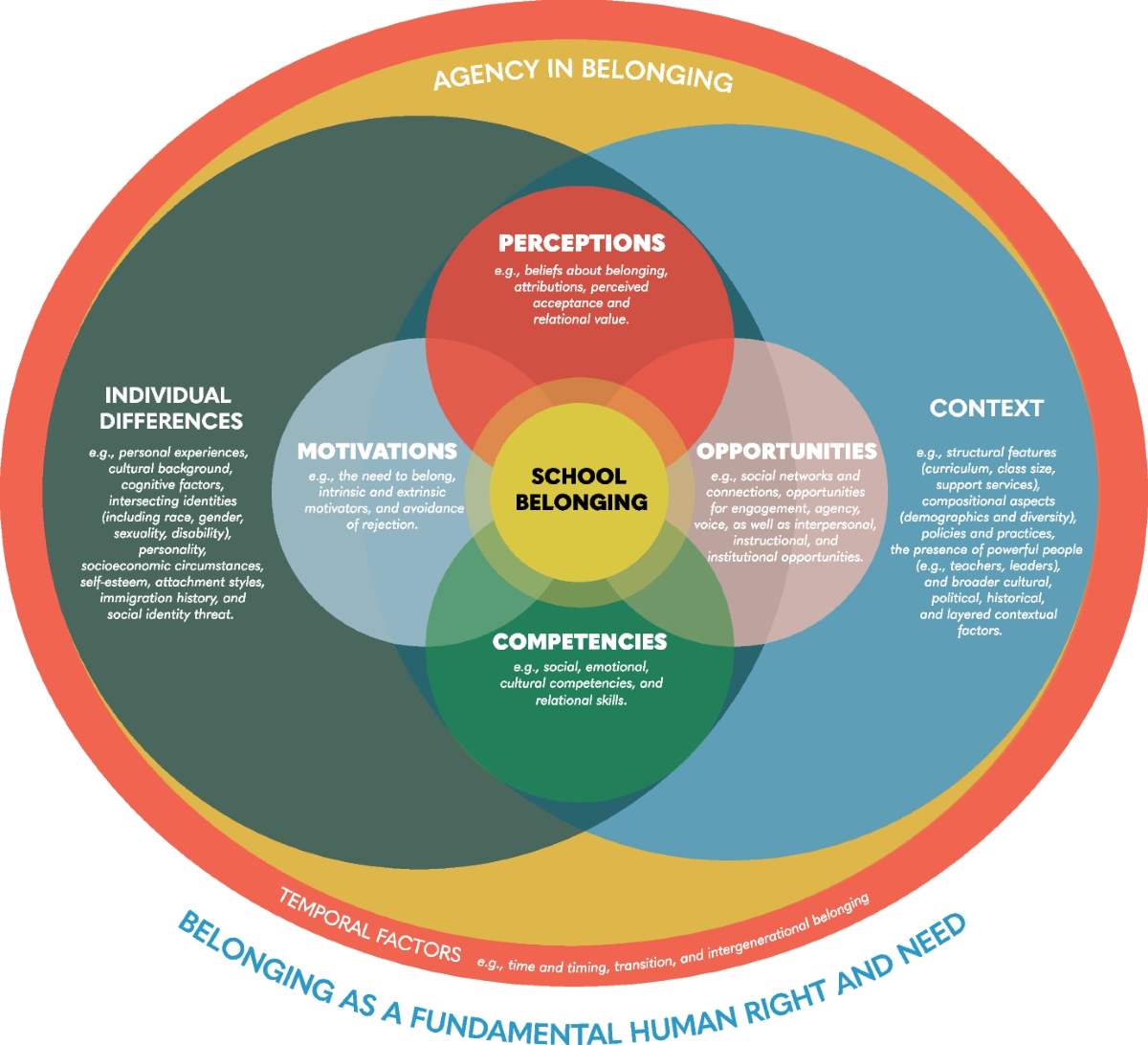
Perceptions refer to how students think and feel about their sense of belonging. That includes whether they feel accepted, included, and valued.
Competencies are the skills that help people build belonging, such as communication, empathy, relationship-building, and cultural understanding.
Motivations involve the human need for connection, acceptance, and meaningful relationships, as well as the desire to avoid rejection.
Opportunities refer to the chances students have to connect with others through clubs, sports, activities, friendships, and relationships with teachers.
Figure 1. Dr Kelly-Ann Allen’s Integrative framework of school belonging
The framework becomes even more useful when we remember that these elements do not operate in a vacuum. They are shaped by school systems, policies, culture, and each student’s identity and experiences. That means belonging is not just an individual feeling. It is also a structural and contextual issue. A student may feel connected in one classroom, disconnected in another, and invisible in the wider school. Belonging changes across time, space, and relationships.
This is where schools need to become more honest. If belonging is shaped by context, then schools cannot simply ask students to “try harder” to fit in. They must examine how their own practices either support or undermine connection.
What schools can do
Teachers have a direct influence on belonging. Approachable, patient, caring teachers who learn students’ names and interests can build trust through daily interactions (Allen & Bowles, 2012). Fair and consistent treatment matters too, especially when students are watching carefully for signs of respect, bias, or exclusion. Student voice is another major factor. When students are invited into decisions, they are more likely to see themselves as genuine members of the school community.
Learning and engagement practices also matter. Collaborative learning, active participation, and differentiated support can help students feel that school is a place where they can contribute and succeed. It is not enough for students to be present; they need to feel that their presence matters. Wellbeing check-ins, involvement in school life, and peer-connection opportunities all strengthen the social fabric of belonging.
A more controversial point is that many schools talk about “care” while still organising everyday life in ways that make belonging uneven. If students only feel valued when they are compliant, high-achieving, or easy to manage, then belonging is conditional. Real belonging requires systems that communicate dignity, fairness, and inclusion even when students are struggling.
Why policy matters
A belonging policy can help make this commitment explicit. It signals that belonging is not a soft extra but a clear institutional priority. A strong policy defines shared values around inclusion and connection, creates consistency across the school, and gives staff, students, and families a common language for action. Most importantly, it turns belonging from an aspiration into an expectation.
Such a policy should be co-created with students, staff, families, and community members. That matters because belonging cannot be imposed from above. It has to be experienced as shared ownership. A policy might include daily check-ins with a trusted adult, structured student voice in curriculum decisions, or expectations for inclusive classroom practice. The key is that it connects principle to routine.
Conclusion
Belonging is not a warm feeling added after the “real” work of schooling. It is part of the real work. Schools that treat belonging as optional will continue to see uneven engagement, well-being, and achievement. Schools that treat belonging as a design principle are more likely to create environments where students can learn, persist, and thrive.
If there is one message to take seriously, it is this: students do not thrive simply because they are enrolled. They thrive when they feel accepted, safe, and able to participate in a school community that recognises their value.
References
Allen, K.-A. (2025). School belonging: Evidence, experts, and everyday gaps. Educational Psychology Review, 37(3), Article 84. https://doi.org/10.1007/s10648-025-10055-x
Allen, K.-A., Kern, M. L., Rozek, C. S., McInerney, D. M., & Slavich, G. M. (2021). Belonging: A review of conceptual issues, an integrative framework, and directions for future research. Australian Journal of Psychology, 73(1), 87–102. https://doi.org/10.1080/00049530.2021.1883409
Allen, K.-A., Kern, M. L., Vella-Brodrick, D., Hattie, J., & Waters, L. (2018). What schools need to know about fostering school belonging: A meta-analysis. Educational Psychology Review, 30(1), 1–34. https://doi.org/10.1007/s10648-016-9389-8
Baumeister, R. F., & Leary, M. R. (1995). The need to belong: Desire for interpersonal attachments as a fundamental human motivation. Psychological Bulletin, 117(3), 497–529. https://doi.org/10.1037/0033-2909.117.3.497
Frydenberg, E., Martin, A. J., & Collie, R. J. (Eds.). (2017). Social and emotional learning in Australia and the Asia-Pacific: Perspectives, programs and approaches. Springer. https://doi.org/10.1007/978-981-10-3394-0
Libbey, H. P. (2004). Measuring student relationships to school: Attachment, bonding, connectedness, and engagement. Journal of School Health, 74(7), 274–283. https://doi.org/10.1111/j.1746-1561.2004.tb08284.x
Maslow, A. H. (1943). A theory of human motivation. Psychological Review, 50(4), 370–396. https://doi.org/10.1037/h0054346
McCahey, A., Allen, K.-A., & Arslan, G. (2021). Information communication technology use and school belonging in Australian high school students. Psychology in the Schools, 58(12), 2392–2403. https://doi.org/10.1002/pits.22600
Thomas, L., Briggs, P., Hart, A., & Kerrigan, F. (2017). Understanding social media and identity work in young people transitioning to university. Computers in Human Behavior, 76, 541–553. https://doi.org/10.1016/j.chb.2017.08.021